Direct Answer
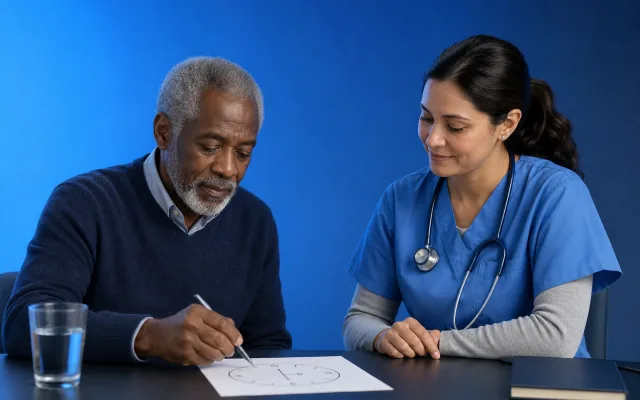
The Mini-Cog is a very brief cognitive screening test that pairs a short word-recall task with a clock-drawing task to help a clinician spot possible thinking or memory changes. It takes about three minutes, is scored out of five points, and is designed as a quick screening step — not a diagnosis (MedlinePlus, National Library of Medicine).
Why the Mini-Cog Matters
The Mini-Cog was created to work like a "cognitive vital sign" — something a clinician can check quickly during a routine visit, the way they check blood pressure. Its developers designed it to be fast and simple enough for busy primary care settings while still being informative (Borson et al., 2000).
One of its practical strengths is that it depends less on a person's education level or first language than some longer tests. In the original development work, the Mini-Cog's diagnostic value was not meaningfully influenced by education or language, which made it useful across diverse populations (Borson et al., 2000). That matters because a brief, accessible screen can be an early, low-burden way to notice a change worth discussing. If you are new to this topic, our overview of cognitive testing explains how screenings fit into the bigger picture of brain health.
What the Mini-Cog Measures
Rather than testing one narrow skill, the Mini-Cog samples two areas that are often affected early when thinking changes:
- Short-term memory — learning a few words and recalling them a moment later
- Executive function and visuospatial skills — organizing and drawing a clock face
Together, these two tasks give a clinician a fast snapshot of memory and planning. The clock-drawing portion also acts as a brief distraction between hearing the words and recalling them, which makes the memory task more meaningful (Hartford Institute for Geriatric Nursing, NYU College of Nursing). Because it is so short, it is best thought of as a first look, not a complete map of cognition. For a wider view of the tools available, see our guide to the types of cognitive tests.
How the Mini-Cog Is Administered
A clinician administers the Mini-Cog in person, usually in about three minutes (MedlinePlus). The provider reads a short list of words for you to remember, asks you to draw a clock showing a specific time, and then asks you to recall the earlier words. The provider records and scores your responses using standardized instructions.
That standardization matters. When the words, timing, and scoring are delivered the same way each time, results are more consistent and easier to interpret. The Mini-Cog is meant to be given and scored by a trained professional rather than completed on your own, which is part of what keeps it reliable. Because it is so brief, it is frequently used during annual wellness visits and other short appointments where a longer test would not fit. If you're curious how screening time compares across tools, we cover how long a cognitive test takes in a separate guide.
Understanding Mini-Cog Scores
The Mini-Cog produces a single total out of five points, combining points for recalling the word list with points for the clock drawing (Hartford Institute for Geriatric Nursing). A higher total suggests a lower likelihood of a cognitive problem, while a lower total suggests that a closer look may be worthwhile.
In practice, clinicians rarely read the score as a simple pass or fail. Several things shape how a result is interpreted:
- Your history — recent changes matter more than a single number
- Daily functioning — how thinking affects everyday activities
- Other findings — mood, sleep, medications, and physical health
- Follow-up over time — one screen is a snapshot, not a trend
How well the Mini-Cog separates people with and without dementia depends on the setting. In a population-based validation study, it identified about 76% of people with dementia (sensitivity) while correctly classifying about 89% of those without it (specificity) — performance broadly comparable to a longer standard screen (Borson et al., 2003). This is why the Mini-Cog is best understood as a clinician-interpreted screening result, not a verdict about your brain.
Can the Mini-Cog Diagnose Dementia?
No. A brief screen like the Mini-Cog cannot, on its own, diagnose dementia, Alzheimer's disease, or any other condition. As the Alzheimer's Association notes, there is no single test that determines whether someone is living with Alzheimer's — clinicians combine cognitive tests with medical history, physical and neurological exams, and sometimes imaging or lab work (Alzheimer's Association).
When a Mini-Cog result is lower than expected, a provider may order additional evaluation to confirm or rule out treatable causes — from thyroid problems and vitamin deficiencies to sleep and mood issues (MedlinePlus). The Mini-Cog is often compared with slightly longer screens such as the MoCA test and the MMSE, which sample more cognitive domains when time allows.
When You Might Take a Mini-Cog
A clinician may use the Mini-Cog if you or a family member has noticed memory or thinking changes, or as a quick check during a routine or wellness visit. Because it is so fast, it is well suited to a first pass that can help decide whether a fuller evaluation makes sense. A concerning result is a prompt for more conversation, not a conclusion.
What Happens Next
After a Mini-Cog, your clinician will explain the result in the context of your overall health and decide, together with you, whether any further steps are worthwhile. Sometimes that is reassurance and a plan to recheck later; other times it is a referral for more detailed testing. Either way, the goal is clarity, not alarm.
Taking the Next Step
To see how a very brief screen differs from a slightly longer one, compare it with our guide to the MoCA test.
To complement clinician-administered screens with a structured check-in you can do from home and share with your doctor, learn how Orena's FDA-cleared at-home test works.
Frequently asked questions
What is the Mini-Cog test?
How long does the Mini-Cog take?
How is the Mini-Cog scored?
Can the Mini-Cog diagnose dementia?
Can I take the Mini-Cog at home?
Sources
- Cognitive Testing — MedlinePlus, National Library of Medicine, 2023
- The Mini-Cog: a cognitive 'vital signs' measure for dementia screening in multi-lingual elderly — International Journal of Geriatric Psychiatry, 2000
- The Mini-Cog as a screen for dementia: validation in a population-based sample — Journal of the American Geriatrics Society, 2003
- Mental Status Assessment of Older Adults: The Mini-Cog — Hartford Institute for Geriatric Nursing, NYU College of Nursing, 2017
- Medical Tests for Diagnosing Alzheimer's — Alzheimer's Association, 2024
Medical disclaimer. This article is for general educational purposes and is not a substitute for professional medical or insurance advice. Orena does not diagnose Alzheimer’s or dementia from a test alone. Always consult your doctor about your specific situation.